
Residential garages
Garage Floor Coatings in Houston
You want the garage done, and you want it to still look right in five years. This page covers what you actually get, what the install is like, and what you need to do to get ready.
What is a garage floor coating, and how is one installed?
Short answer
A garage floor coating is a multi-layer resin system, not a paint. The slab is diamond ground to open the concrete, cracks and spalls are repaired, a pigmented epoxy base coat is applied, decorative flake is broadcast into it while wet, and a clear polyaspartic topcoat locks everything down and takes the wear.
Professional recommendation
For a working residential garage in this climate, a flake system over a properly ground slab is the right default, and I recommend it more often than everything else combined.
- Choose it when
- The garage is used as a garage — vehicles, tools, foot traffic — and you want a floor that stays looking clean between cleanings and hides what concrete naturally does.
- Look elsewhere when
- The slab has unresolved structural movement, or moisture testing shows significant vapor drive. Fix the cause first; a coating over either of those is money spent twice.
Houston Superior Epoxy
At a glance
- Installation time
- A typical residential garage is a multi-day installation because grinding, base coat, broadcast and topcoat each have to happen in sequence with cure time between them. The specific schedule for your floor is confirmed in writing before work starts.
- Return to service
- Foot traffic returns before vehicle traffic. Exact hours are set by the installed system’s technical data sheet and by cure-day temperature and humidity, so they are given in writing at the final walkthrough rather than published as a fixed number.
- Preparation method
- Mechanical diamond grinding with dust control. Never acid etching.
- Warranty
- 5-year written workmanship warranty
- What drives cost
- Square footage, though not linearly — mobilisation is a fixed cost spread across the area
- Slab condition: existing coating removal, crack and spall repair, and stem wall work are separate scopes
- System specified — a full-broadcast flake floor and a metallic floor are different labour
- Access and obstructions, including whether the garage is emptied before the crew arrives
What changes
What a coated garage floor actually does for you
Not a feature list — the six differences homeowners tell us they notice.
Day-to-day
A floor you can actually clean
Bare concrete is porous, so it absorbs oil, brake dust and whatever came off your tires. A coated floor is a sealed surface — spills sit on top and come up with a mop instead of staining permanently.
Day-to-day
No more concrete dust
Untreated slabs shed a fine grey powder that ends up on everything stored in the garage. Sealing the surface stops it at the source.
Durability
Hot-tire resistance
A warm tire sitting on a poorly bonded coating pulls it away from the slab. Resistance to that comes from mechanical bond and a proper topcoat, not from a product claim on a box.
Durability
Cracks dealt with, not hidden
Cracks and spalls are repaired as their own step before coating. A crack painted over is still a crack, and it will telegraph back through the finish.
Appearance
Brighter, more usable space
A finished light-reflective floor makes a significant difference to how bright a garage feels with the door shut, which matters if you use the space for anything besides parking.
Appearance
A finish chosen in your own garage
Flake blends read completely differently under your lighting than on a screen. We bring physical samples to the estimate so the choice is made in the room it is going in.
Scope
What is included in a residential garage install
- Onsite inspection of the slab before any number is quoted
- Professional diamond grinding with dust-control equipment
- Crack, spall and surface repair as a separate itemized step
- Flake broadcast to full refusal, then scraped and vacuumed even
- Polyaspartic clear topcoat where appropriate for the system
- Stem walls and curbs coated if you want them included
- Final walkthrough with care instructions for your specific floor
- Written 5-year workmanship warranty
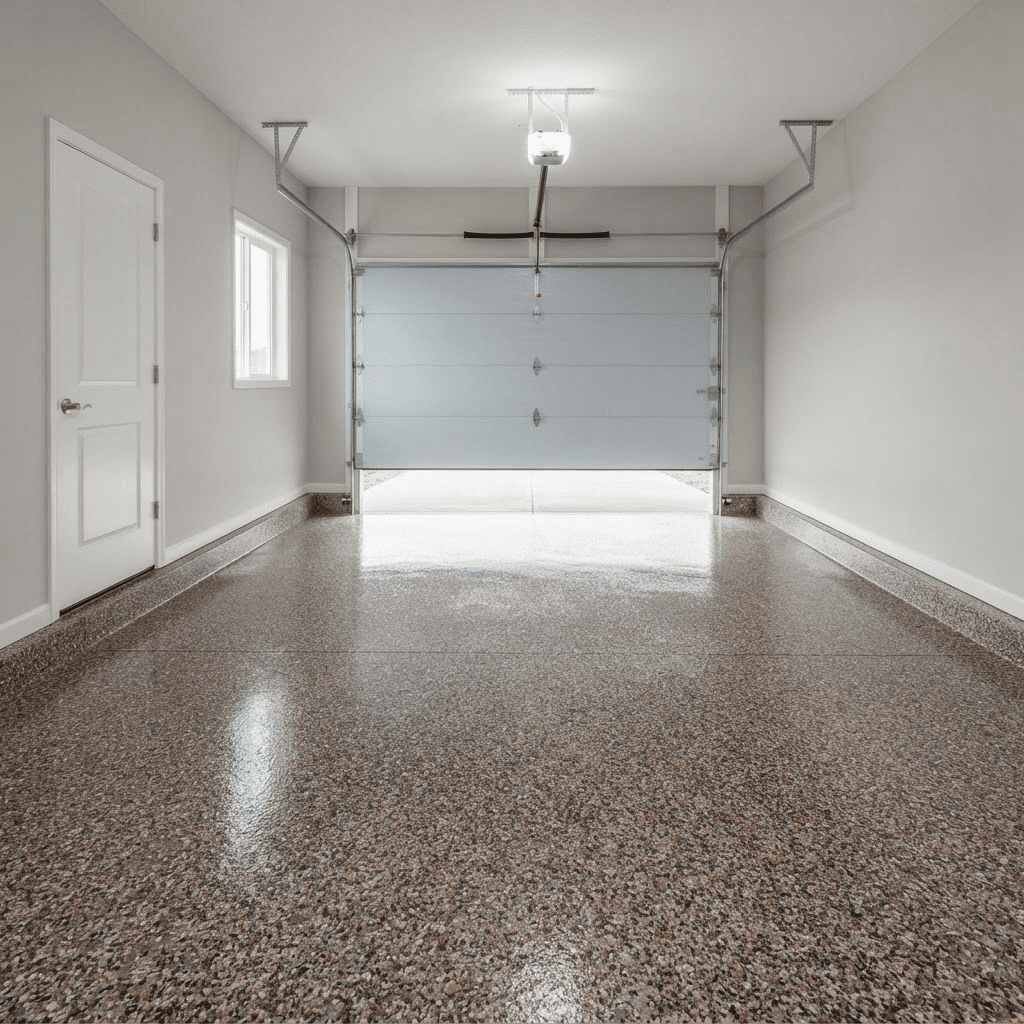
That is an illustration of a finished flake floor rather than a photograph of one of ours — it shows the full-broadcast finish and the coved stem-wall detail listed above. Photography of our own garages is being shot for the project archive, and we are not filling this space with a stock image of somebody else's garage.
The install
What the job is like from your side
Three things homeowners want to know before they commit: what they have to do, what it is like while it happens, and when they get the space back.
Before we arrive
The garage needs to be empty — everything off the floor, and vehicles parked elsewhere for the duration of the install. Wall-mounted storage can usually stay, though anything within a few inches of the floor is easier to work around if it comes down.
If you have a floor drain, a water heater, or a step down into the house, mention it when we schedule. Those are detail areas that affect how we sequence the work.
While the work happens
Grinding is the loud, dusty part, and it is done with dust-control equipment rather than left to settle over your house. You do not need to be home for it, but the garage door will be open for airflow during parts of the install.
Once coating starts, the floor cannot be walked on until it has set. We tell you exactly when you get the space back at the point we hand over the schedule.
Getting your garage back
Foot traffic and vehicle traffic return at different points, and the sequence depends on the system installed and the conditions during the install. Your schedule comes with your itemized quote after the inspection, so you can plan around it rather than guess.
At the final walkthrough we go over the floor together and leave you with care instructions specific to the system on your slab.
Terms used on this page
- Laitance
- A weak, dusty layer of fine cement particles brought to the surface during concrete finishing. A coating applied over laitance bonds to the laitance rather than to the slab, which is why the floor can peel away in sheets while the coating film itself is undamaged.
- Concrete surface profile (CSP)
- The ICRI scale describing how rough a prepared concrete surface is, from CSP 1 (nearly smooth) upward. Coating manufacturers name a target CSP in their data sheets; diamond grinding is how that profile is produced repeatably.
- Hot-tire pickup
- Coating lifting from the slab where a warm tire sits. The tire softens the film and grips it as the rubber cools. The underlying cause is almost always inadequate bond to the concrete or a coating driven on before full cure — not a coating that was insufficiently hard.
- Polyaspartic
- An aliphatic polyurea coating chemistry used as a clear topcoat. Being aliphatic, it is UV stable, which is why it goes on top of an epoxy base rather than the other way round. It also cures quickly, which shortens return-to-service but narrows the window an installer has to work the material.
- Epoxy
- A two-part thermosetting resin used as a base coat. It bonds strongly into ground concrete and builds thickness well. It is aromatic, so it ambers and chalks under sustained sunlight — a documented property of the chemistry, and the reason it belongs underneath a UV-stable topcoat.
- Aliphatic
- A class of polymer chemistry that resists ultraviolet degradation. Aliphatic coatings such as polyaspartics and aliphatic urethanes hold their colour in sunlight; aromatic chemistries such as standard epoxy do not.
- Moisture vapor transmission
- Water vapor moving upward through a concrete slab from the soil beneath it. If the surface is sealed, pressure can build under the coating and lift it osmotically. Recognised test methods are ASTM F1869 (anhydrous calcium chloride) and ASTM F2170 (in-situ relative humidity probes).
Questions
Garage-specific questions
Do I have to empty my whole garage?
Yes, the floor needs to be completely clear, and vehicles parked elsewhere for the duration. Wall storage can typically stay in place. We will confirm what needs to move when we schedule the install.
Will you coat the stem walls too?
We can. Coating up the stem walls or curbs is additional detail and cut-in work beyond the floor area, so it appears as its own line on your quote rather than being assumed either way.
How long before I can park on it?
Foot traffic and vehicle traffic come back at different points, and the timing depends on the system and the conditions during installation. You get a specific schedule with your itemized quote after the onsite inspection.
Which system should I pick for a working garage?
Most Houston homeowners end up on a full-broadcast flake system, because the flake layer hides slab imperfections, adds texture underfoot and disguises dust well. Metallic is the more dramatic option and solid color is the simplest. We talk through the trade-offs onsite.
Can you match a specific color?
Flake blends are selected from physical samples during your estimate. Blend and coverage choices do affect material cost, which is covered in the itemized quote.
Get an itemized quote after we have seen your concrete
Every estimate is free, happens onsite, and comes back itemized. No payment is due upfront.
- $2M general liability + workers’ comp
- 5-year workmanship warranty
- No upfront payment