
System detail
Full-Broadcast Flake Garage Floors
The system most Houston garages end up with. Vinyl flake broadcast into a wet epoxy base until the surface will not take more, then scraped flat and locked under polyaspartic.
What is a full-broadcast flake garage floor?
Short answer
Vinyl chips thrown into a wet epoxy base coat until the surface will not accept more — the point of refusal — so the base coat is completely hidden. The cured flake layer is then scraped back, vacuumed, and sealed under a clear polyaspartic topcoat. A light scatter that leaves base coat showing is a cheaper, different floor.
Professional recommendation
This is the system I specify most often for residential garages, and the single thing worth arguing about in a flake quote is whether the broadcast goes to refusal.
- Choose it when
- The garage is in daily use, the slab needed repair work you would rather not see, or you want texture underfoot instead of a slick surface.
- Look elsewhere when
- You specifically want a seamless, mirror-flat finish. Flake is a texture; if that is not what you are after, a solid colour or metallic is the honest answer.
Houston Superior Epoxy
Where this system fits
Best for
- Daily-use residential garages with vehicles and foot traffic
- Slabs that needed crack or spall repair — the blend disguises patch lines better than any other finish
- Households that want grip underfoot rather than a slick surface
- Anyone who would rather not see every footprint and tyre mark between cleanings
Not recommended when
- Rooms where a seamless, mirror-flat finish is the actual goal
- Slabs with untested or active moisture vapor transmission — that gets resolved first, whatever the finish
- Spaces needing a specific measured DCOF slip rating, which is specified with aggregate rather than assumed from flake texture
At a glance
- Installation time
- A multi-day installation: grind, base coat, broadcast flake to refusal, scrape and vacuum the excess, then clear topcoat. Each stage needs the previous one cured.
- Return to service
- Foot traffic returns before vehicle traffic. Exact hours are set by the installed system’s technical data sheet and by cure-day temperature and humidity, so they are given in writing at the final walkthrough rather than published as a fixed number.
- Preparation method
- Mechanical diamond grinding with dust control. Never acid etching.
- Warranty
- 5-year written workmanship warranty
- What drives cost
- Whether the broadcast is full — to refusal — or partial, which changes flake volume substantially
- Area, slab condition and repair scope
- Number of clear coats over the broadcast
The build
Six layers, bottom to top
Every one of these is a discrete step. The order is not flexible, and skipping any of them is what produces a floor that fails early.
Ground slab — diamond-ground to an open profile so the resin has something mechanical to key into.
Repairs — cracks, spalls and pitting filled and levelled as their own step, before any coating.
Base coat — pigmented epoxy, which does the adhesion work and provides the background color.
Flake broadcast — vinyl chips thrown into the wet base to full refusal, meaning until the surface will not take more.
Scrape and vacuum — the cured flake layer is scraped back and vacuumed so the surface is even underfoot rather than sharp.
Polyaspartic topcoat — the clear layer that locks the flake down and takes the traffic, UV and chemical exposure.
The detail that matters
What “broadcast to refusal” actually looks like
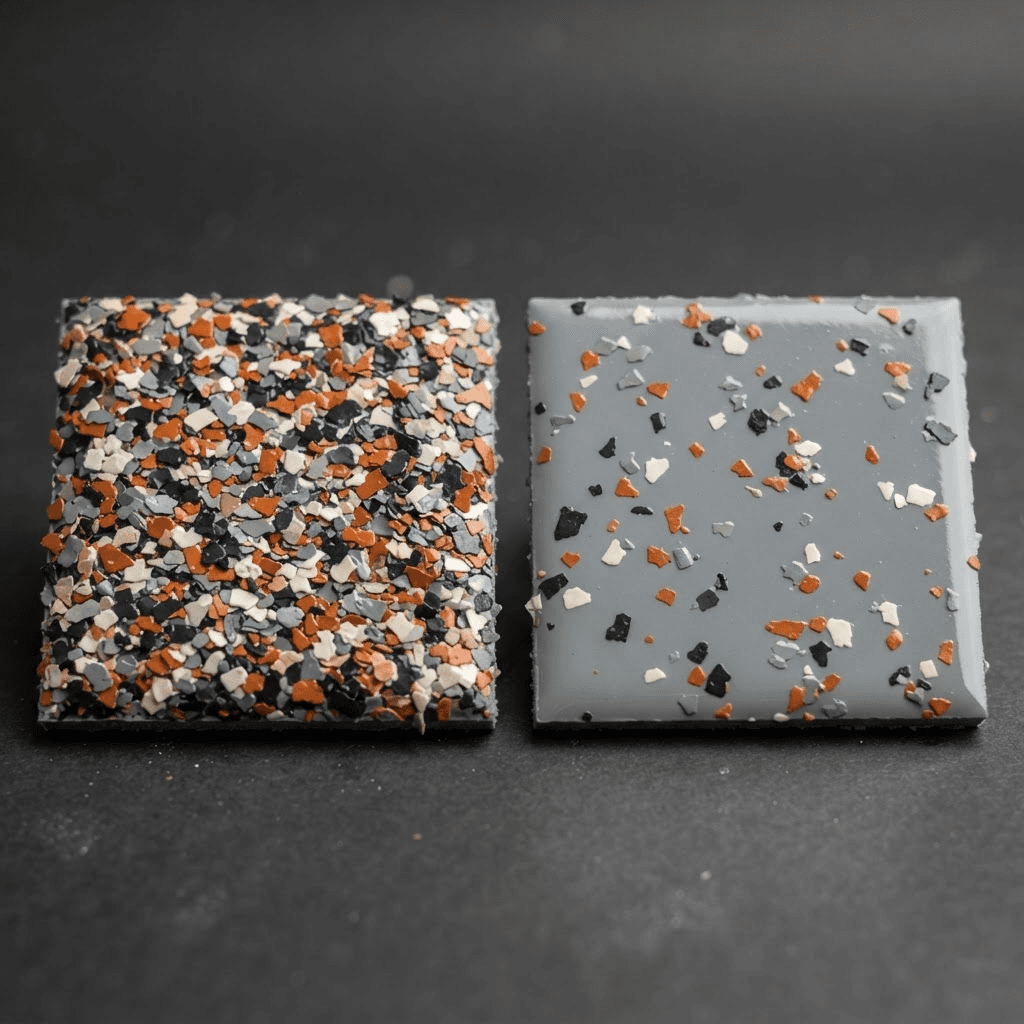
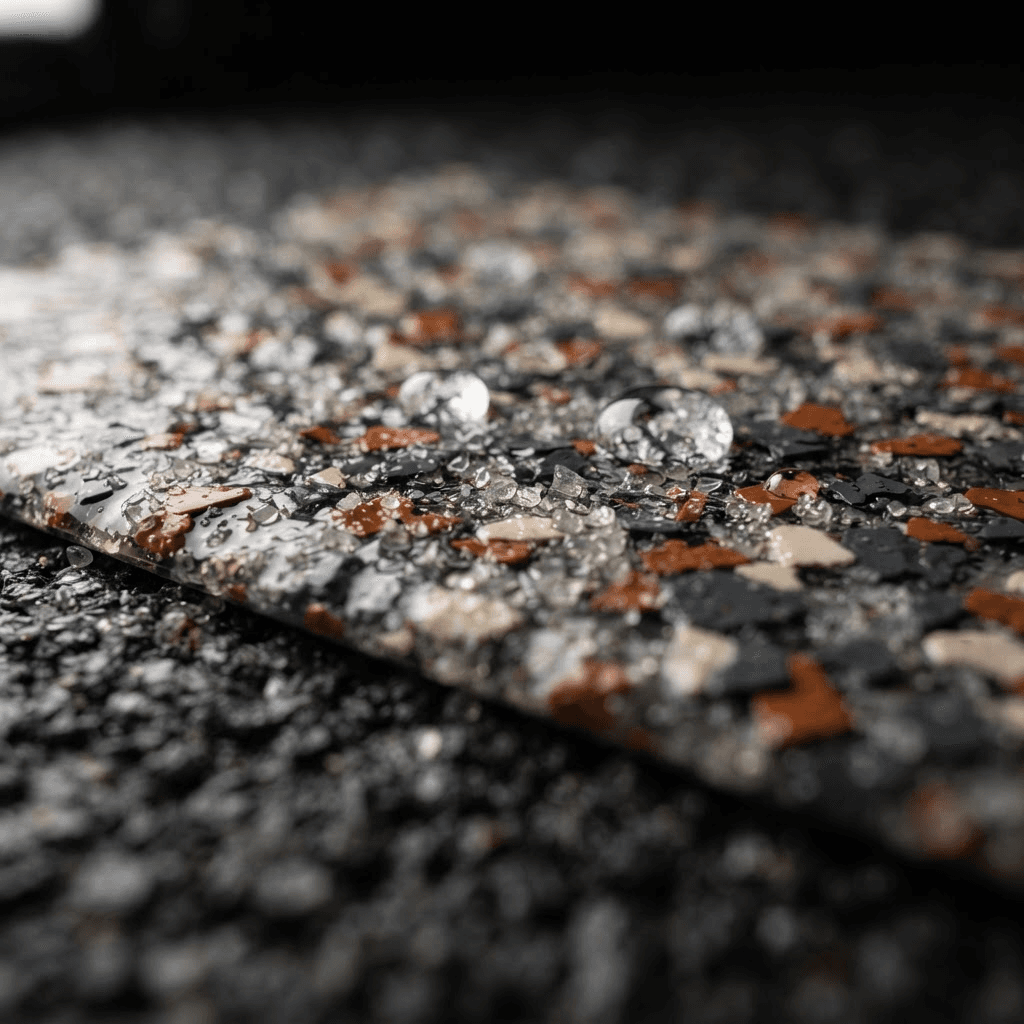
Refusal means flake is fed into the wet base coat until the surface will not accept another chip. It is the difference between a flake floor and a floor with some flake on it, and it is visible in the coupon long before it is visible in a warranty claim.
Why this system
What flake does that other finishes do not
Six reasons this is the default recommendation for a working residential garage.
Appearance
It hides what concrete does
A slab is never perfectly uniform, and a solid color shows every variation in it. The visual noise of a flake blend disguises minor imperfections, patch lines and repairs far better than a flat finish.
Safety
Texture you can feel
The scraped flake layer leaves a subtle profile rather than a slick surface. That matters in a garage where a wet tire or a spilled bottle would otherwise make a smooth floor genuinely slippery.
Day-to-day
It disguises dust and tire marks
A dark solid floor shows every footprint and every bit of dust. A multi-tone blend breaks that up visually, which is why flake floors look cleaner between cleanings.
Appearance
Blend controls the whole room
Chip size, color mix and how densely it is broadcast completely change the read of the floor — from a fine, near-uniform speckle to a bold high-contrast terrazzo effect.
Build quality
Full refusal is the differentiator
Broadcasting to refusal uses substantially more flake than a light scatter. It is the single biggest visual and cost difference between a proper flake floor and a cheap one that shows base coat through the gaps.
Build quality
Repairs disappear into it
On a slab that needed crack or spall work, flake is the most forgiving finish available. The same repair under a solid color or metallic is much more likely to remain visible.
Scope
What a flake install includes
- Diamond grinding with dust-control equipment
- Crack, spall and pitting repair as an itemized step
- Pigmented epoxy base coat
- Flake broadcast to full refusal
- Scrape and vacuum of the cured flake layer
- Polyaspartic clear topcoat
- Stem walls and curbs on request, itemized separately
- Written 5-year workmanship warranty
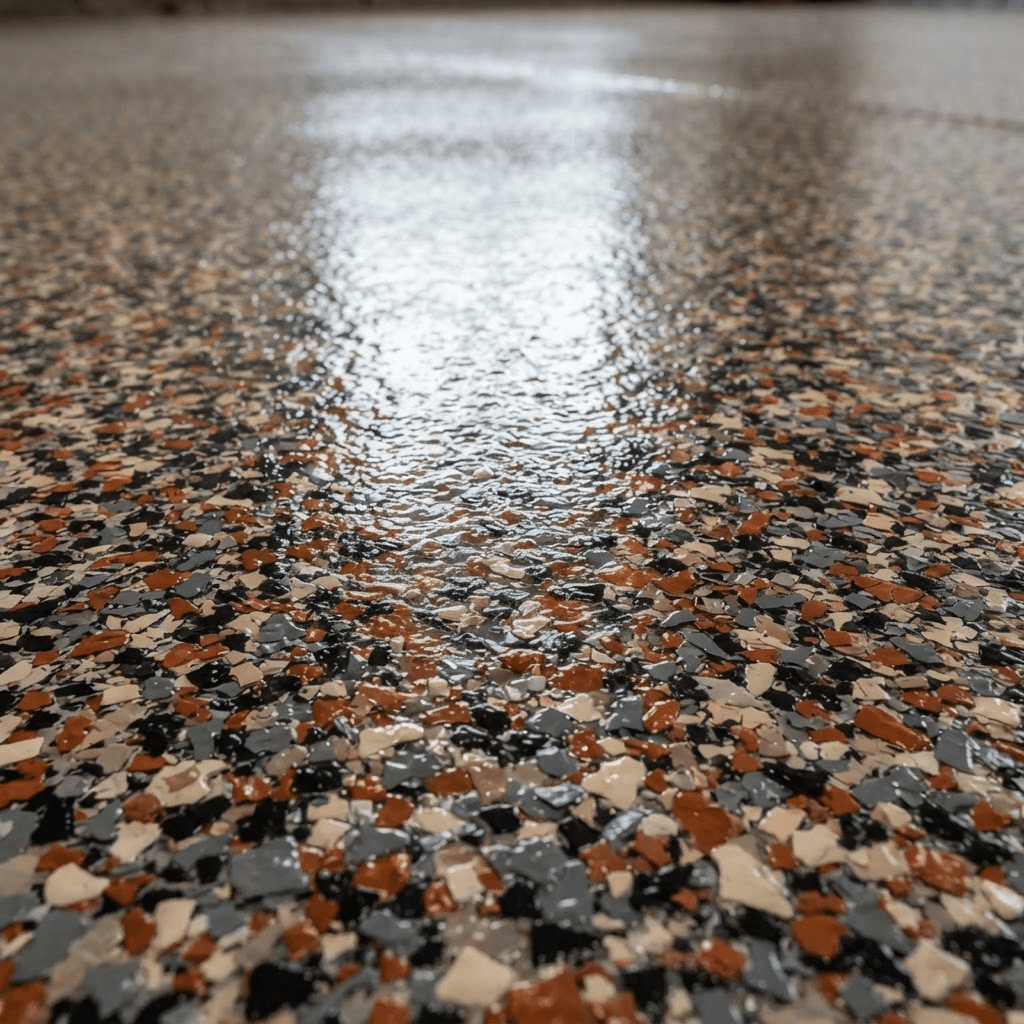
The image above is an illustration of the finished surface, not one of our installs — photography of completed Houston-area floors is being added to the project archive. Flake blends also read differently under your own lighting, so confirm a blend against a physical sample rather than a screen.
The detail
Three things worth understanding
These are the points where a flake floor is either built properly or quietly cheapened.
What "broadcast to refusal" actually means
The flake is thrown into the wet base coat by hand, continuously, until the surface will not accept any more chips — the point of refusal. Done properly the base coat is completely obscured, and what you see is a solid layer of flake rather than chips scattered across a colored floor.
This is where a lot of quotes quietly differ. A "flake system" broadcast lightly uses a fraction of the material, and you can see the base coat between the chips. It costs less because it is less floor. If you are comparing quotes, ask specifically whether the broadcast is to refusal.
Why the floor gets scraped after the flake cures
Flake broadcast to refusal does not land flat. Chips stand up at angles, and the raw cured surface is sharp enough to be unpleasant barefoot and difficult to topcoat evenly.
So once the base has cured with the flake in it, the whole floor is scraped back and thoroughly vacuumed. That knocks down the high edges, produces a consistent profile and gives the topcoat a uniform surface to flow over. Skipping it is why some flake floors feel rough and look uneven.
Choosing a blend in your own garage
Flake blends read completely differently under your lighting than they do on a screen or in a showroom. Garage lighting is usually cooler and more directional than the light a sample was photographed in, and the size of the room changes how busy a blend looks.
We bring physical samples to the estimate so the decision gets made in the room the floor is going in, under the light it will actually live under. Blend choice does affect material cost, so it is reflected in the itemized quote rather than assumed.
Terms used on this page
- Full-broadcast
- A flake floor in which vinyl chips are thrown into the wet base coat until the surface will not accept more, so the base coat is completely hidden. The alternative — a light scatter — leaves base coat visible between chips and uses a fraction of the material.
- Refusal
- The point during a flake broadcast at which the wet base coat will not hold any more chips. "Broadcast to refusal" is the specification; it is the clearest single thing to compare between two flake quotes.
- Epoxy
- A two-part thermosetting resin used as a base coat. It bonds strongly into ground concrete and builds thickness well. It is aromatic, so it ambers and chalks under sustained sunlight — a documented property of the chemistry, and the reason it belongs underneath a UV-stable topcoat.
- Polyaspartic
- An aliphatic polyurea coating chemistry used as a clear topcoat. Being aliphatic, it is UV stable, which is why it goes on top of an epoxy base rather than the other way round. It also cures quickly, which shortens return-to-service but narrows the window an installer has to work the material.
- Aliphatic
- A class of polymer chemistry that resists ultraviolet degradation. Aliphatic coatings such as polyaspartics and aliphatic urethanes hold their colour in sunlight; aromatic chemistries such as standard epoxy do not.
- Concrete surface profile (CSP)
- The ICRI scale describing how rough a prepared concrete surface is, from CSP 1 (nearly smooth) upward. Coating manufacturers name a target CSP in their data sheets; diamond grinding is how that profile is produced repeatably.
- DCOF
- Dynamic coefficient of friction — the measured standard for slip resistance, tested under ANSI A326.3. It is a number produced by a test, which is why we describe slip resistance in terms of what aggregate is added rather than with adjectives.
Questions
Flake system questions
What does "broadcast to refusal" mean?
Flake is thrown into the wet base coat until the surface will not take any more. The base coat ends up completely covered, so you see a solid flake layer rather than chips scattered over a colored floor. It uses considerably more material than a light broadcast, and it is the main thing to compare between flake quotes.
Is a flake floor slippery?
The scraped flake layer leaves a subtle texture rather than a slick surface, which is one of the practical reasons it suits garages. If you want more grip than standard — for a wet area or a slope — that is a conversation we have during the estimate.
Can I pick any color combination?
Blends are selected from physical samples we bring to your estimate, so you see them under your own lighting. Chip size, color mix and broadcast density all change how the floor reads, and they do affect material cost, which shows on the itemized quote.
Will the flake come loose over time?
The flake is locked between the base coat it was thrown into and the polyaspartic topcoat over it, so it is encapsulated rather than sitting on the surface. Failure in a flake floor almost always starts at the bond between the base coat and the concrete, which is why the grinding step matters so much.
Does flake hide cracks I have repaired?
It is the most forgiving finish we install in that respect. A repair under a solid color or a metallic finish is much more likely to stay visible; the visual noise of a flake blend disguises patch lines well. The repair still has to be done properly first.
How is this different from a solid color floor?
A solid color is a pigmented coating with no decorative broadcast — simpler, flatter and smoother. Flake adds a texture layer and visual complexity that hides slab imperfections and dust. Both are legitimate; the solid color page covers when it is the better call.
Get an itemized quote after we have seen your concrete
Every estimate is free, happens onsite, and comes back itemized. No payment is due upfront.
- $2M general liability + workers’ comp
- 5-year workmanship warranty
- No upfront payment