
Preparation & remediation
Epoxy Coating Removal & Resurfacing
If your floor is peeling, bubbling or lifting under your tires, something went wrong underneath it. Removal starts with working out what failed and why — because that determines the method, the cost, and occasionally whether removal is needed at all.
How is a failed epoxy floor removed?
Short answer
Mechanically. The old coating is ground off with diamond tooling until sound concrete is exposed, which also reveals why the previous floor failed — usually a slab that was never properly ground, or moisture that was never tested. That diagnosis matters, because a new system over the same unresolved cause fails the same way.
Professional recommendation
The removal is straightforward; the diagnosis is the valuable part. If nobody tells you why the last floor failed, you are buying the same outcome again.
- Choose it when
- An existing coating is peeling, bubbling or delaminating, or you want a different system than what is currently down.
- Look elsewhere when
- The existing floor is sound and only looks tired. In that case a recoat assessment is the cheaper starting point, and we will say so.
Houston Superior Epoxy
At a glance
- Installation time
- Quoted as a separate stage ahead of the new floor. Duration depends on how many layers there are and how well they are bonded, which is why it is inspected before it is quoted.
- Return to service
- Foot traffic returns before vehicle traffic. Exact hours are set by the installed system’s technical data sheet and by cure-day temperature and humidity, so they are given in writing at the final walkthrough rather than published as a fixed number.
- Preparation method
- Mechanical diamond grinding with dust control. Never acid etching.
- Warranty
- 5-year written workmanship warranty
- What drives cost
- Number of coats and how tenaciously they are bonded — a well-bonded old floor is harder to remove
- Coating type, since some soften and load the tooling
- Slab damage revealed underneath, which is genuinely unknown until removal
- Area and access for equipment and dust control
Coating failure is not random
Each way a floor comes apart points to a specific cause, and the cause matters more than the symptom. It tells us whether the whole system has to come off, whether only the topcoat is compromised, and whether the slab underneath has a problem that will take out the next floor too.
This is also the job type where we are most likely to talk someone out of work. Removal is the largest single variable in a coating quote. If your existing floor is sound and the issue is cosmetic, saying so costs us a line item and saves you a great deal of money.
Why we will not quote removal from photographs
The cost is driven by how tenaciously the old coating is stuck and what condition the slab is in beneath it. Neither is visible in a photo. A floor that looks catastrophic can lift off quickly; a floor with one peeling corner can be bonded like stone everywhere else.
We can tell you from photos what we would need to check. The adhesion testing that actually determines the number happens at the onsite inspection.
Diagnosis
What the failure is telling us
Identify what your floor is doing and you are most of the way to knowing why. Bring photos of the worst areas to your estimate.
Adhesion
Peeling in sheets
The coating lifts away in large flexible pieces, often with clean grey concrete underneath. The coating never bonded, which almost always traces back to preparation — acid etching or a quick scuff instead of mechanical grinding.
Moisture
Bubbling and blistering
Small domes across the surface, sometimes holding moisture. Vapor drove up out of the slab faster than the coating could handle, or it went down over concrete still releasing water. Common on Houston slabs with no vapor barrier beneath them.
Product
Hot tire pickup
Coating lifts in patches exactly where tires park. Hot rubber softens an under-cured or low-grade film and pulls it off the slab. Largely a thin single-part product problem, not something we see on a cured polyaspartic topcoat.
UV
Yellowing and chalking
The floor has gone amber, or leaves powder on your hand. Aromatic epoxy is not UV-stable, so sun exposure drives discoloration. The film may still be bonded — sometimes this is a topcoat problem, not a full-removal problem.
Substrate
Cracking that follows the slab
The coating has split along a line running through the concrete. The slab moved and the coating went with it. Repairing the coating without addressing the crack means it comes straight back.
Recoat
Delamination between coats
The topcoat separates from the base coat while the base stays stuck to the slab. Recoat windows were missed, or the surface was contaminated between passes. Sometimes only the top layer needs to come off.
A floor showing more than one of these usually has a preparation problem at the root. Hot tire pickup plus peeling in sheets is not two failures — it is one under-bonded coating failing in the two places it gets stressed hardest.
Sequence
How a removal job runs
Diagnose before removing anything — how the failure presents, adhesion tested in several spots, moisture checked. What failed and why determines the method, and occasionally says the floor can stay.
Determine the method — well-bonded coatings need aggressive grinding or shot blasting; loose coatings may scrape first. Thick industrial buildups can take multiple passes.
Mechanical removal under HEPA vacuum extraction — the same dust-controlled equipment as standard prep, running longer and more aggressively.
Expose and assess the bare slab. This is the part nobody can quote in advance: previous repairs, spalling that was coated over, or moisture problems all surface here.
Repair the concrete — cracks, spalls and pitting as their own step. Frequently more work on a removal job, because problems were buried rather than fixed.
Profile and re-inspect — once clean and repaired, the slab is ground to the profile the new system needs, then inspected again before product goes down.
Install the new system — base coat, broadcast where appropriate, scrape, and topcoat, exactly as on any other floor.
The honest part
The slab under a failed floor is an unknown until it is exposed
On a bare slab we can see almost everything during the estimate. On a removal job, the old coating is hiding the concrete.
We test adhesion, check moisture and read the failure pattern, and that gets us a well-founded number. But the full picture only arrives once the coating is off.
We handle that by itemizing removal separately in your written quote and by telling you immediately if what we expose changes the scope. What we will not do is give you a confident flat number over the phone and then revise it upward mid-job.
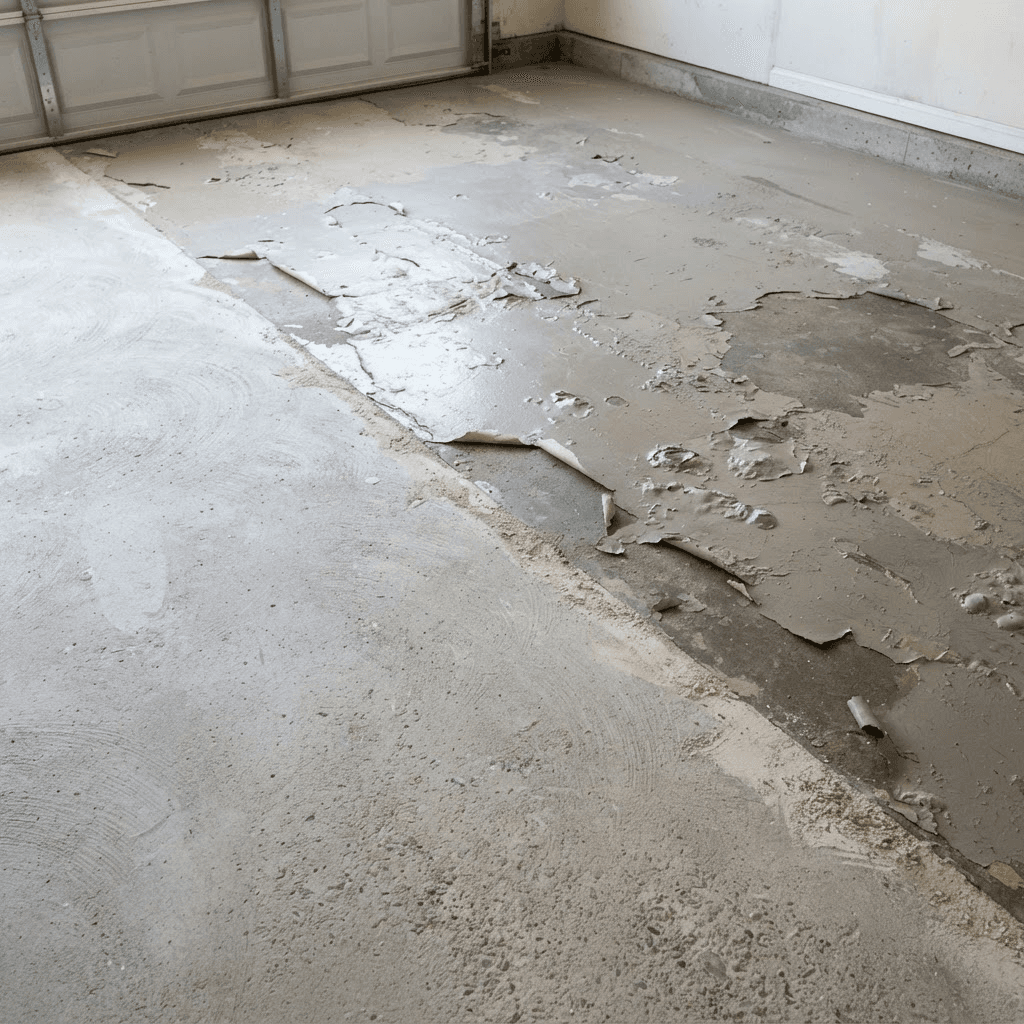
That is an illustration of what removal looks like partway through — failed coating lifting on one side, stripped slab on the other — rather than a photograph of one of our jobs. Removal photography is being shot on live jobs for the project archive, so it will show real slabs at the point the old coating comes up.
Terms used on this page
- Laitance
- A weak, dusty layer of fine cement particles brought to the surface during concrete finishing. A coating applied over laitance bonds to the laitance rather than to the slab, which is why the floor can peel away in sheets while the coating film itself is undamaged.
- Concrete surface profile (CSP)
- The ICRI scale describing how rough a prepared concrete surface is, from CSP 1 (nearly smooth) upward. Coating manufacturers name a target CSP in their data sheets; diamond grinding is how that profile is produced repeatably.
- Hot-tire pickup
- Coating lifting from the slab where a warm tire sits. The tire softens the film and grips it as the rubber cools. The underlying cause is almost always inadequate bond to the concrete or a coating driven on before full cure — not a coating that was insufficiently hard.
- Mil thickness
- Coating thickness measured in thousandths of an inch. Target thickness is specified by the coating manufacturer for the specific product and application, so we quote it from the technical data sheet for the system going on your slab rather than publishing a general figure.
- Spall
- A patch where the concrete surface has flaked, chipped or broken away, leaving a shallow crater. Spalls are repaired and levelled as their own step before any coating is applied.
Questions
Removal and resurfacing
Can you just coat over my failed epoxy floor?
Not if the existing coating has lost adhesion. Anything applied on top of a floor that is already letting go will fail on the same schedule, because the weak link is underneath. If the old coating is genuinely well bonded and the problem is limited to the topcoat, a recoat can sometimes work — but that determination requires adhesion testing onsite, not a photograph.
Is removal always necessary?
No, and we will tell you when it is not. Sometimes the base coat is sound and only the topcoat has failed. Sometimes what you are seeing is UV yellowing on a film that is still fully bonded. Removal is expensive and we would rather not sell it when the concrete does not need it.
How much more does a removal job cost than a bare slab?
Meaningfully more, because you are paying for the removal labor and then for everything a bare slab would have needed anyway. It is also the line item with the widest range, since it depends on adhesion and on what the slab looks like once exposed. Your written quote itemizes removal separately so you can see exactly what that portion costs.
What if you find problems after the old coating comes off?
We tell you before we proceed. If removal exposes something that changes the scope — an unexpected moisture problem, or spalling that was coated over rather than repaired — we stop, show you, and give you the revised number. You will not find out about it on the invoice.
How long does a removal job add to the schedule?
It depends entirely on how the old coating behaves and what the exposed slab needs. Removal is its own phase before preparation even begins, and repairs on a previously coated slab often take longer than on bare concrete. We give you a realistic schedule with the written quote rather than an optimistic one.
Send us photos of what your floor is doing
Text pictures of the worst areas and we will tell you which failure mode it looks like and what we would need to test onsite. Adhesion testing happens at the free estimate.
- $2M general liability + workers’ comp
- 5-year workmanship warranty
- No upfront payment
Before you hire anyone
How to Choose a Garage Floor Coating Company in Houston
Fourteen checks, what a good answer sounds like, and the questions to read aloud during an estimate. Written to be used against us as readily as anyone else.
Continue reading
- Grinding & PrepHow a slab gets profiled once the old coating is gone.
- Crack & Spall RepairDamage that was coated over instead of repaired.
- PolyasparticWhy the replacement topcoat matters.
- Epoxy FlooringReading a quote so this does not happen twice.
- PricingWhere removal sits in the cost breakdown.
- Garage FloorsChoosing the replacement system.