
Technical comparison
Polyaspartic Floor Coatings in Houston
Most pages treat epoxy and polyaspartic as two products to choose between. They are usually layers in the same floor doing different jobs. Here is how each one behaves, and what that means on a Houston slab.
What is a polyaspartic coating, and why is it used as a topcoat?
Short answer
Polyaspartic is an aliphatic polyurea used as the clear top layer of a floor system. Being aliphatic, it resists ultraviolet light, so it holds colour where an epoxy left on top would amber. It also cures quickly, which shortens return to service but narrows the window an installer has to work the material.
Professional recommendation
Polyaspartic belongs on top of an epoxy base, not instead of it. A single-layer polyaspartic floor sold as an upgrade is usually a thinner floor at a higher price.
- Choose it when
- You want the wear and UV performance of a modern topcoat, or the space gets real sunlight — a sun-exposed patio, a garage that stands open all day.
- Look elsewhere when
- Someone is offering it as a one-coat replacement for a full system. The fast cure is a workmanship demand, and in inexperienced hands it produces a worse floor than a slower product would.
Houston Superior Epoxy
At a glance
- Installation time
- Applied as the final layer of a multi-day system. The fast cure shortens the wait between coats but does not compress the whole installation into one day.
- Return to service
- Foot traffic returns before vehicle traffic. Exact hours are set by the installed system’s technical data sheet and by cure-day temperature and humidity, so they are given in writing at the final walkthrough rather than published as a fixed number.
- Preparation method
- Mechanical diamond grinding with dust control. Never acid etching.
- Warranty
- 5-year written workmanship warranty
- What drives cost
- Area and number of clear coats
- Whether anti-slip aggregate is suspended in the topcoat
- The base system it is going over
The misconception
Layers, not rivals
Understanding which layer does what makes every quote you read easier to interpret.
They are not competitors — they are layers
The most common misunderstanding is treating "epoxy floor" and "polyaspartic floor" as two products you pick between. In practice a well-built floor is a system of layers, and the two chemistries are doing different jobs at different depths.
Epoxy is generally the base. Its strength is adhesion: applied to a properly ground slab it wets into the open concrete profile and creates the mechanical bond the whole floor depends on. Polyaspartic is generally the topcoat. Its strengths are UV stability, abrasion resistance and speed.
So when a quote says "polyaspartic floor," the useful question is not which chemistry it is, but what is in each layer and what is underneath all of it. A polyaspartic topcoat over an unprepared slab is still going to fail, because the failure happens at the concrete, not at the top.
Where a single-layer approach makes sense
Not every slab needs a decorative multi-layer build. A warehouse that needs dust control and a cleanable surface may be better served by a simpler pigmented system, and a straightforward seal is sometimes the correct specification rather than a compromise.
What does not make sense is a decorative floor with a fast topcoat over preparation that was skipped to save time. That is the combination that produces a floor which looks excellent for one season.
How we decide which system your slab gets
The specification comes out of the onsite inspection, not from a catalogue. What the concrete is doing, whether it has been coated before, how the space is used and how much sun it sees all feed into which layers get specified.
We name the products on the quote so you can look them up. Citadel SLE-100 and Polyaspartic F61 are what we typically build with, and if your slab calls for something different we tell you why.
Side by side
How the two chemistries behave
Qualitative behavior only. We do not publish performance figures we cannot substantiate — check those against manufacturer data.
| Polyaspartic | Epoxy | |
|---|---|---|
| Role in the system | Topcoat. It goes over a cured base and takes the abuse — traffic, UV, chemicals. | Base coat. It wets into the ground concrete profile and creates the bond to the slab. |
| UV stability | Stable in sunlight, which is why it is the right call on anything exposed. | Ambers over time under UV — a clear epoxy left in the sun yellows. |
| Cure speed | Fast. This is what compresses install timelines and lets a floor get its topcoat sooner. | Slower, which is a feature in the base coat — it gives the resin time to penetrate. |
| Working window | Short. Less room for error, so it rewards a crew that has done it repeatedly. | Longer and more forgiving to place and flatten. |
| Temperature and humidity sensitivity | Sensitive — cure behavior shifts with ambient conditions, which matters a great deal in Houston. | Also sensitive, particularly to a cold or damp slab, but over a longer window. |
| Film character | Tougher, more flexible film, better at resisting abrasion and scratching. | Harder and more rigid; excellent adhesion, less forgiving of slab movement. |
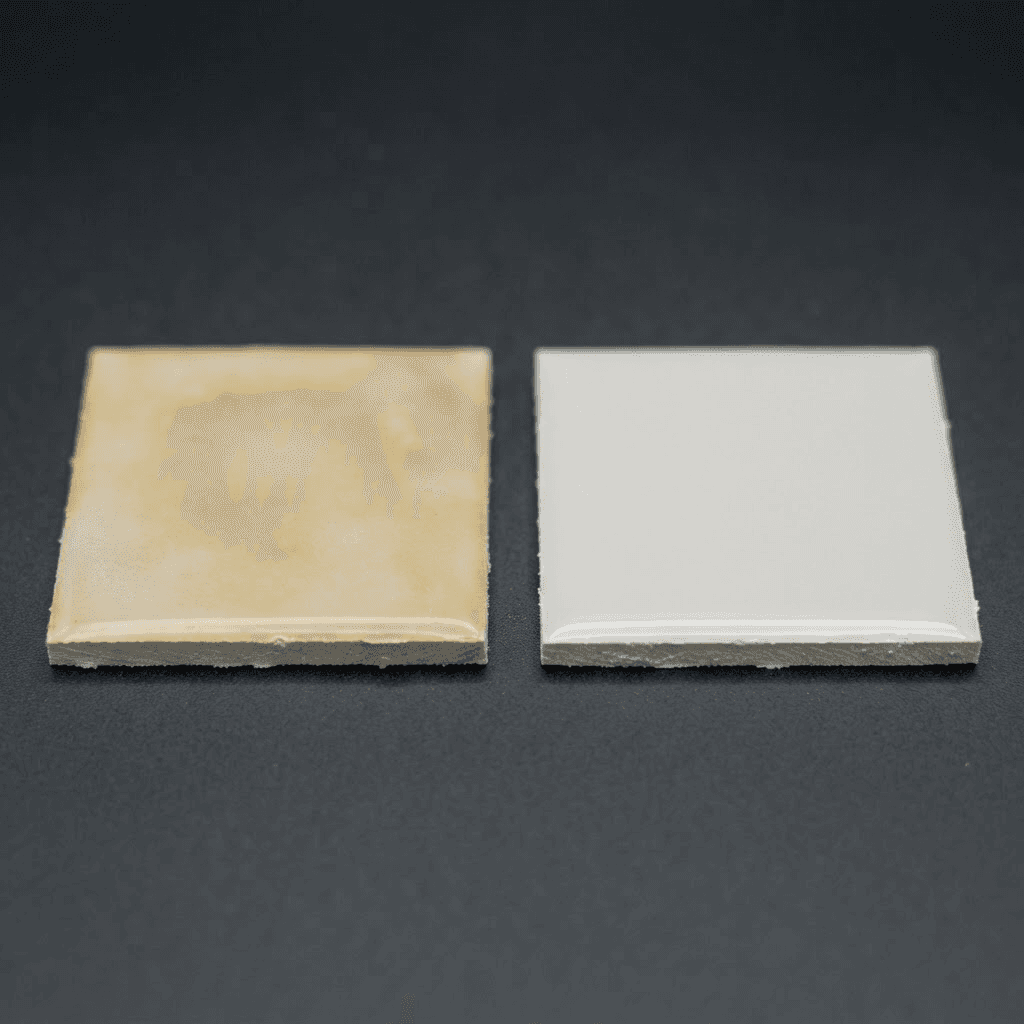
What UV does
Ambering is the visible difference
An aromatic epoxy topcoat yellows and chalks under sustained UV. It is a property of the resin, not a defect in the installation, and no maintenance schedule reverses it. A UV-stable polyaspartic topcoat holds its clarity, so the flake blend you chose still reads as the colour you chose.
This is why the topcoat matters more than the pigment on anything with sun on it — a patio, a pool deck, or a garage that sits open through a Houston afternoon. On a fully enclosed slab with no daylight, the distinction is much less important, and we will tell you so rather than sell up.
Local conditions
Six things that matter specifically here
Coating behavior is not climate-neutral. These are the Houston-specific factors that feed into which system a slab gets.
Climate
Heat during the install
Both chemistries cure faster as temperature rises, and polyaspartic already has a short working window. On a hot Houston slab that window gets shorter still, which is a scheduling and crew-experience issue rather than a product problem.
Climate
Humidity and slab moisture
Concrete on grade in this region can carry meaningful moisture, and moisture moving up through a slab is a bonding problem for any coating. This is why slab condition gets assessed before a system is specified.
Exposure
Direct sun on exterior slabs
A patio or pool deck is under UV all day. A clear epoxy exposed like that will amber, so exterior work gets a UV-stable topcoat instead. This is the clearest case where the chemistry choice is not a preference.
Exposure
Hot tires in a closed garage
A warm tire parked on a coating puts sustained heat and pressure on one spot. Resistance comes primarily from how well the base coat is mechanically bonded to a ground slab, and secondarily from the toughness of the topcoat film.
Substrate
Slab movement
Regional soils move, and slabs move with them. A more flexible topcoat film handles minor movement better than a rigid one, though no coating substitutes for repairing cracks properly first.
Schedule
Getting the space back sooner
Fast cure is the practical reason polyaspartic dominates as a topcoat. It shortens the gap between the last coat and the moment you can use the room again.
Terms used on this page
- Polyaspartic
- An aliphatic polyurea coating chemistry used as a clear topcoat. Being aliphatic, it is UV stable, which is why it goes on top of an epoxy base rather than the other way round. It also cures quickly, which shortens return-to-service but narrows the window an installer has to work the material.
- Aliphatic
- A class of polymer chemistry that resists ultraviolet degradation. Aliphatic coatings such as polyaspartics and aliphatic urethanes hold their colour in sunlight; aromatic chemistries such as standard epoxy do not.
- Epoxy
- A two-part thermosetting resin used as a base coat. It bonds strongly into ground concrete and builds thickness well. It is aromatic, so it ambers and chalks under sustained sunlight — a documented property of the chemistry, and the reason it belongs underneath a UV-stable topcoat.
- Mil thickness
- Coating thickness measured in thousandths of an inch. Target thickness is specified by the coating manufacturer for the specific product and application, so we quote it from the technical data sheet for the system going on your slab rather than publishing a general figure.
- Hot-tire pickup
- Coating lifting from the slab where a warm tire sits. The tire softens the film and grips it as the rubber cools. The underlying cause is almost always inadequate bond to the concrete or a coating driven on before full cure — not a coating that was insufficiently hard.
Questions
Technical questions
Is polyaspartic better than epoxy?
The question does not quite work, because they usually are not alternatives. Epoxy is normally the base coat providing adhesion to the slab, and polyaspartic is normally the topcoat providing UV stability and abrasion resistance. Most quality floors use both.
Why does polyaspartic cost more?
The material costs more per unit, and it is less forgiving to install because the working window is short. That combination means both higher material cost and a crew that has to move deliberately.
Can polyaspartic go directly on concrete?
There are single-layer applications, but for decorative floors the layered approach is standard because the base coat is what handles adhesion to the prepared slab. Which approach your floor gets is decided at the inspection.
Will my floor turn yellow?
A clear epoxy exposed to sustained UV will amber over time — that is a known behavior of the chemistry. It is exactly why exterior slabs and sun-exposed interiors get a UV-stable topcoat instead of a clear epoxy left on top.
Does Houston humidity affect the install?
Yes. Ambient temperature and humidity affect cure behavior, and moisture in the slab itself affects bonding. Both are assessed before we specify a system, and both can affect scheduling.
What products do you install?
We typically build with Citadel SLE-100 and Polyaspartic F61, and the products appear by name on your quote. We do not publish performance figures for them — look them up against the manufacturer data rather than taking a contractor’s numbers.
Get an itemized quote after we have seen your concrete
Every estimate is free, happens onsite, and comes back itemized. No payment is due upfront.
- $2M general liability + workers’ comp
- 5-year workmanship warranty
- No upfront payment