
System detail
Metallic Epoxy Floors
Pearlescent pigment moved through wet resin by hand. The result has real depth and genuinely cannot be repeated — which is the appeal, and also the thing to understand before you choose it.
What is a metallic epoxy floor?
Short answer
A metallic epoxy floor uses reflective pigments suspended in clear resin, manipulated while wet to produce depth and movement that reads like polished stone. Every floor is unique and none can be reproduced exactly. It is a decorative finish first, and it shows dust and scuffing more readily than a flake floor does.
Professional recommendation
Metallic is the right call when the floor is meant to be looked at rather than worked on. In a busy two-car garage it is a higher-maintenance choice than most people expect.
- Choose it when
- The room is a showroom, a display garage, a retail space or a feature area, and visual impact is the point.
- Look elsewhere when
- The space is a working garage with tool chests, jack stands and grit tracked in. You will see every scuff, and the finish cannot be spot-repaired invisibly.
Houston Superior Epoxy
Where this system fits
Best for
- Display and collector garages where the floor is part of the presentation
- Retail, showroom and office spaces wanting a seamless feature floor
- Anyone who wants a floor that is genuinely one of a kind
Not recommended when
- Working garages with heavy tool traffic, dragged equipment or tracked-in grit
- Owners who want a predictable, repeatable appearance — no two pours match
- Anyone unwilling to dust and damp mop more often than a flake floor needs
At a glance
- Installation time
- A multi-day installation, and the decorative coat cannot be rushed. Schedule confirmed in writing before work starts.
- Return to service
- Foot traffic returns before vehicle traffic. Exact hours are set by the installed system’s technical data sheet and by cure-day temperature and humidity, so they are given in writing at the final walkthrough rather than published as a fixed number.
- Preparation method
- Mechanical diamond grinding with dust control. Never acid etching.
- Warranty
- 5-year written workmanship warranty
- What drives cost
- Complexity of the effect and the number of pigments involved
- Labour, which is the dominant factor — metallic is skill-intensive
- Area, slab condition and clear coat specification
Character
What the finish is actually like
Three things that make metallic worth choosing, and three trade-offs that come with it. Both halves matter.
Character
No two floors are the same
Metallic pigment is moved through the wet resin by hand. The pattern that results is a record of how the material was worked on that day, in that room — it cannot be repeated exactly, including by us.
Character
Depth rather than pattern
The pigment suspends at different levels in the resin, so the finish reads as having depth below the surface rather than being a printed pattern sitting on top of it.
Character
It changes with the light
Pearlescent pigment reflects differently depending on where you stand and where the light is coming from. The same floor genuinely looks different morning and evening.
Trade-off
Smoother than flake
There is no decorative broadcast, so the finished surface is considerably smoother. That is part of the appeal indoors and part of the reason it is a poor fit for wet areas.
Trade-off
It shows the slab underneath
Without a flake layer to break things up visually, a metallic finish is far less forgiving of an uneven or patched slab. Slab condition matters more here than in any other system we install.
Trade-off
It shows daily life too
A smooth reflective floor shows dust, footprints and scuffing more readily than a multi-tone flake blend. It rewards a space that gets kept clean.
Good fit
Where metallic works well
- Showrooms and retail where the floor is part of the presentation
- Interior feature spaces — entries, lobbies, studios
- Home gyms, bars and finished basements
- Offices where a decorative floor replaces carpet or tile
- Display garages that are kept clean rather than worked in
- Interior slabs in genuinely good condition
Poor fit
Where we would talk you out of it
- Exterior patios and pool decks — UV and wet-slip both work against it
- Wet areas, or any slab that regularly sees standing water
- Warehouse and forklift traffic, where abrasion dominates
- Slabs with extensive patching that you want disguised
- Working garages where the floor takes constant abuse and rarely gets cleaned
- Anywhere an exactly repeatable finish is a requirement
Expectations
The honest version
Metallic is the finish most likely to disappoint someone who chose it from a photograph. Here is why, and what we will and will not promise.
Why we talk about this one differently
Metallic is the most photogenic floor we install, and photographs are exactly the problem. What you find on the internet is a selection of the most dramatic results ever produced, generally shot in ideal light in an empty room. That is a fair representation of the ceiling of the finish, not of the average.
The reality is that metallic is hand-worked, and the outcome depends on the resin, the room temperature, the slab and the person working it. We can show you the character of the finish and the palette. We cannot promise a specific pattern, and anybody who does is describing something they do not control.
What we can commit to
The palette and the general character — how light or dark, how high-contrast, how much movement. The preparation underneath, which is the same diamond-ground standard as every other system we install. The topcoat over it. The warranty on the workmanship.
What we will not do is show you somebody else’s floor and imply yours will match it.
Slab condition matters more here
Because there is no flake layer breaking up the surface visually, a metallic floor telegraphs what is underneath it more than any other finish. An uneven slab, an old patch or a repaired crack is more likely to remain perceptible.
That is not a reason to avoid metallic — it is a reason for the inspection to be honest. If your slab is not a good candidate for metallic we will tell you during the estimate and explain what we would recommend instead, rather than taking the job and hoping.
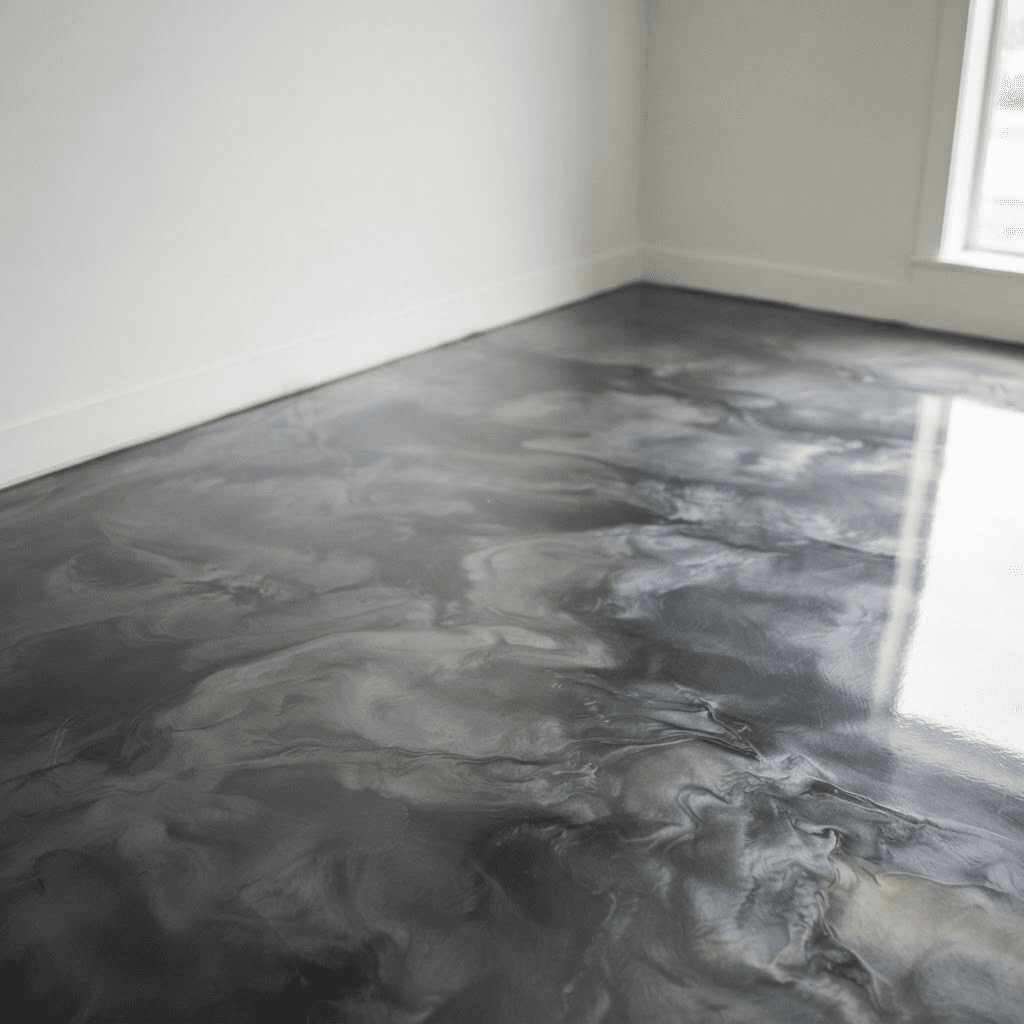
And this is a case in point: an illustration of a metallic pour, not a photograph of a floor we installed. It is the kind of image metallic gets sold on, which is exactly why your own floor should be judged from physical samples in your room instead. Photography of our own completed metallic floors is being shot for the project archive.
Terms used on this page
- Epoxy
- A two-part thermosetting resin used as a base coat. It bonds strongly into ground concrete and builds thickness well. It is aromatic, so it ambers and chalks under sustained sunlight — a documented property of the chemistry, and the reason it belongs underneath a UV-stable topcoat.
- Polyaspartic
- An aliphatic polyurea coating chemistry used as a clear topcoat. Being aliphatic, it is UV stable, which is why it goes on top of an epoxy base rather than the other way round. It also cures quickly, which shortens return-to-service but narrows the window an installer has to work the material.
- Aliphatic
- A class of polymer chemistry that resists ultraviolet degradation. Aliphatic coatings such as polyaspartics and aliphatic urethanes hold their colour in sunlight; aromatic chemistries such as standard epoxy do not.
- Mil thickness
- Coating thickness measured in thousandths of an inch. Target thickness is specified by the coating manufacturer for the specific product and application, so we quote it from the technical data sheet for the system going on your slab rather than publishing a general figure.
- DCOF
- Dynamic coefficient of friction — the measured standard for slip resistance, tested under ANSI A326.3. It is a number produced by a test, which is why we describe slip resistance in terms of what aggregate is added rather than with adjectives.
- Concrete surface profile (CSP)
- The ICRI scale describing how rough a prepared concrete surface is, from CSP 1 (nearly smooth) upward. Coating manufacturers name a target CSP in their data sheets; diamond grinding is how that profile is produced repeatably.
Questions
Metallic questions
Can you match a metallic floor I saw online?
Not exactly, and neither can anyone else. The pattern comes from how pigment is hand-worked through wet resin, so it is never precisely repeatable. We can match the palette and the general character — how dark, how much contrast, how much movement — but a specific pattern is not something any installer genuinely controls.
Is metallic good for a garage?
It can be, for a display garage that gets kept clean. For a working garage, flake is usually the better call: it hides dust and tire marks, has more texture underfoot and is far more forgiving of slab imperfections.
Can I have a metallic patio?
We do not recommend it. Exterior slabs deal with UV and get wet with people walking on them, and a smooth metallic finish is the wrong answer to both. Exterior work gets a textured, UV-stable system instead.
Is it slippery?
It is smoother than a flake floor because there is no decorative broadcast, so it has less inherent texture. That is fine for a dry interior space and a genuine consideration anywhere that gets wet. We will raise it if the space you have in mind is a concern.
Does it need more maintenance?
Not fundamentally different maintenance, but a smooth reflective surface shows dust and footprints more readily than a multi-tone flake blend, so it looks like it needs attention sooner. Care instructions specific to your floor come at the final walkthrough.
Why is metallic priced differently to flake?
Different material and, more significantly, different labor — the pigment has to be worked while the resin is open, which is skilled, time-sensitive work. Which one costs more on your specific slab depends on the slab, so both get quoted from the inspection rather than from a rate card.
Get an itemized quote after we have seen your concrete
Every estimate is free, happens onsite, and comes back itemized. No payment is due upfront.
- $2M general liability + workers’ comp
- 5-year workmanship warranty
- No upfront payment