
Commercial & industrial
Commercial Epoxy Flooring in Houston
For a business, the floor is secondary to the downtime. We phase commercial installs around your operating hours, carry $2M in coverage, and put the day-by-day sequence in writing before anything starts.
What is involved in a commercial epoxy floor installation?
Short answer
Commercial work is scheduled around your operations rather than ours — often overnight or in phases so the space keeps running. The technical sequence matches residential work: grind, repair, base coat, topcoat. What differs is scale, specified tolerances, and requirements such as slip resistance and chemical exposure driving which system is used.
At a glance
- Quick answer
- Commercial work is scoped around downtime and use, not just square footage — the schedule is usually the hardest constraint.
- Best for
- Retail, warehouse, workshop and institutional slabs
- Facilities that need a cleanable, inspectable surface
- Projects that can be phased around operating hours
- Not recommended when
- The facility cannot release any area for the sequence of grind, coat and cure
- Slab moisture has not been assessed on a large pour
- The specification is being driven purely by lowest bid, which is where preparation gets cut
- Installation time
- Scoped per project and phased around your operating hours. The written quote states the sequence and the areas released at each stage.
- Return to service
- Foot traffic returns before vehicle traffic. Exact hours are set by the installed system’s technical data sheet and by cure-day temperature and humidity, so they are given in writing at the final walkthrough rather than published as a fixed number.
- Preparation method
- Mechanical diamond grinding with dust control. Never acid etching.
- Warranty
- 5-year written workmanship warranty
- What drives cost
- Total area and how many phases the work has to be split into
- Out-of-hours or weekend working to protect operations
- Slab condition across a large pour, including joints and moisture
- System specified for the actual traffic — foot, pallet or forklift
Operations first
How we keep you running
The scope items commercial clients actually negotiate on — all of them itemized rather than assumed.
- Phased installation so part of the space stays operational
- After-hours, overnight and weekend scheduling
- Dust-control equipment on all grinding, not open-air grinding
- Containment and protection of adjacent finished areas
- Certificate of insurance issued to your property manager on request
- Coordination with your building management and access requirements
- Line striping and traffic marking as a separate itemized scope
- Written 5-year workmanship warranty on the installed floor
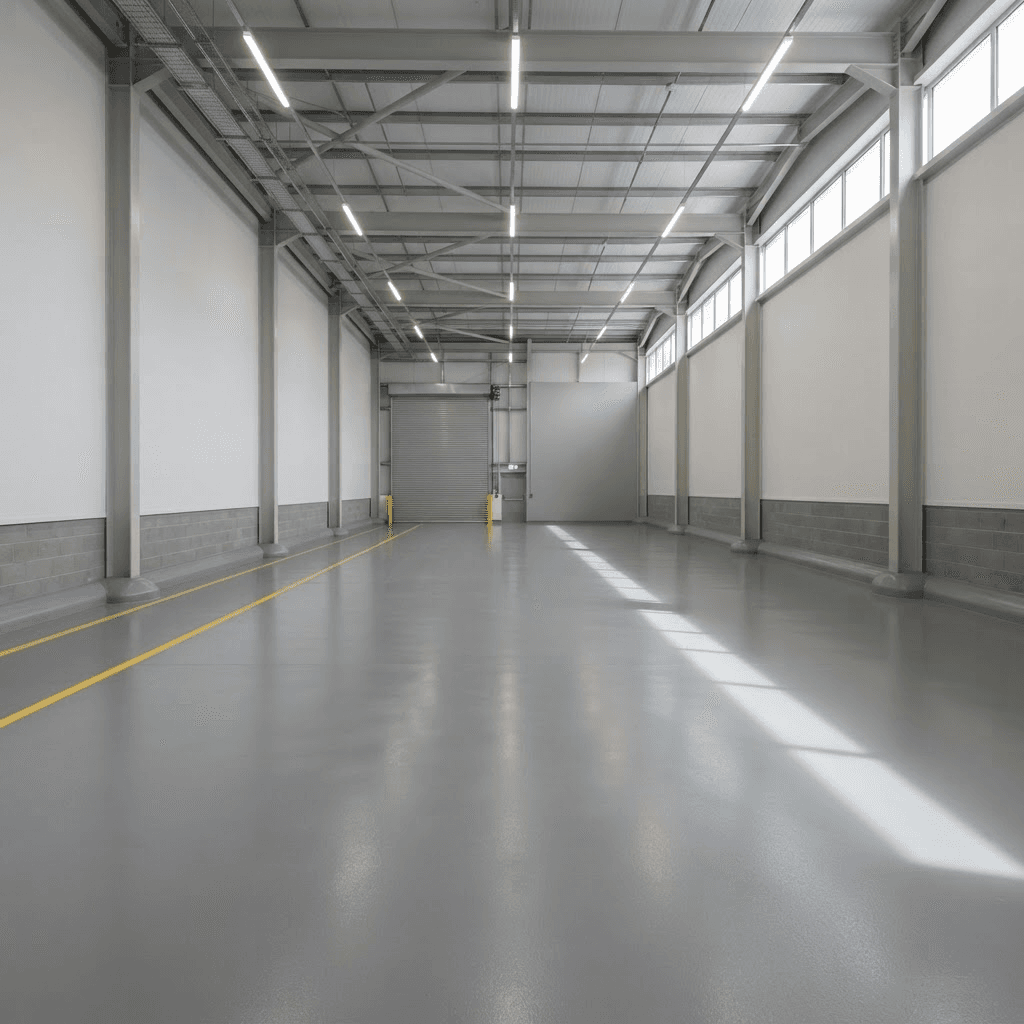
That is an illustration of an industrial coating and safety-line layout rather than a photograph of one of our installs. Commercial project photography is being shot on completed jobs for the project archive, rather than licensed from a stock library.
Sectors
Spaces we coat
Different sectors drive different specifications. What the floor has to survive determines the system, not the other way round.
Sector
Retail and showrooms
Customer-facing floors where appearance carries weight and the space cannot be closed for long. Usually phased so a portion stays open, or run overnight.
Sector
Automotive and service bays
Slabs that see oil, brake fluid, hot tires and rolling tool chests. Chemical resistance and a cleanable surface matter more than finish drama.
Sector
Commercial kitchens and food service
Health-code-driven work where a seamless, sanitary, non-absorbent surface is the point. Coving and drain detail get assessed during the walkthrough.
Sector
Medical and veterinary
Spaces that need to be disinfected repeatedly without degrading the floor. Seamlessness matters because seams collect what you are trying to remove.
Sector
Gyms and studios
High foot traffic, dropped weight, and equipment dragged across the surface. Abrasion and impact behavior drive the specification.
Sector
Offices and lobbies
Where a polished decorative finish is doing architectural work. Metallic and solid-color systems both come into play.
Planning
Downtime, liability and access
The three things that decide whether a commercial floor project goes smoothly, all settled before work begins.
Downtime is a scoping decision, not a surprise
The question every operator asks first is how long the space is unusable. The honest answer is that it depends on the square footage, the condition of the slab, the system specified and how much of the space can be closed at one time — which is why the schedule comes out of the walkthrough rather than off a rate card.
What we can commit to is that you get the sequence in writing before work starts, including which areas are down on which days and when each returns to service. Phasing costs more in mobilization than doing the whole floor at once, and that trade-off is yours to make with real numbers in front of you.
Liability and access
We carry $2 million in general liability plus workers’ compensation, and we will issue a certificate naming your entity or property manager if your lease requires it. For tenants in managed buildings, that requirement usually surfaces late and delays a start date — raising it during the walkthrough avoids that.
Access logistics matter as much as the coating. Loading dock availability, freight elevator hours, after-hours building access and where equipment can be staged all affect the schedule, so we cover them onsite.
What the walkthrough covers
We assess slab condition, existing coatings, moisture, joint and crack detail, drain locations and traffic patterns. For warehouse and industrial slabs there is additional detail around joint treatment and forklift loading, covered on the warehouse page.
You receive an itemized proposal: preparation, repair, each coating layer, striping if applicable, phasing and mobilization broken out separately. No payment is due upfront.
Terms used on this page
- Epoxy
- A two-part thermosetting resin used as a base coat. It bonds strongly into ground concrete and builds thickness well. It is aromatic, so it ambers and chalks under sustained sunlight — a documented property of the chemistry, and the reason it belongs underneath a UV-stable topcoat.
- Polyaspartic
- An aliphatic polyurea coating chemistry used as a clear topcoat. Being aliphatic, it is UV stable, which is why it goes on top of an epoxy base rather than the other way round. It also cures quickly, which shortens return-to-service but narrows the window an installer has to work the material.
- Concrete surface profile (CSP)
- The ICRI scale describing how rough a prepared concrete surface is, from CSP 1 (nearly smooth) upward. Coating manufacturers name a target CSP in their data sheets; diamond grinding is how that profile is produced repeatably.
- Laitance
- A weak, dusty layer of fine cement particles brought to the surface during concrete finishing. A coating applied over laitance bonds to the laitance rather than to the slab, which is why the floor can peel away in sheets while the coating film itself is undamaged.
- Moisture vapor transmission
- Water vapor moving upward through a concrete slab from the soil beneath it. If the surface is sealed, pressure can build under the coating and lift it osmotically. Recognised test methods are ASTM F1869 (anhydrous calcium chloride) and ASTM F2170 (in-situ relative humidity probes).
- DCOF
- Dynamic coefficient of friction — the measured standard for slip resistance, tested under ANSI A326.3. It is a number produced by a test, which is why we describe slip resistance in terms of what aggregate is added rather than with adjectives.
Questions
Commercial questions
Can you work outside our business hours?
Yes. After-hours, overnight and weekend scheduling is standard for commercial work, and phasing so part of the space stays open is common. Both affect cost through mobilization, so they appear as their own line rather than being hidden in a square-foot rate.
How long will our space be out of service?
It depends on area, slab condition, the system specified and how much can be closed at once. You get a written day-by-day sequence with your proposal after the walkthrough, so you can plan staffing and deliveries around it.
Can you issue a certificate of insurance to our landlord?
Yes. We carry $2M general liability plus workers’ compensation and can issue a certificate naming your entity or property manager. If your lease has specific coverage or additional-insured requirements, send them over during the walkthrough.
Do you handle line striping and safety marking?
Yes, as a separate itemized scope. Traffic lanes, walkways and equipment zones are quoted distinctly from the floor coating because they are often phased differently or added later.
Is the grinding going to shut down the rest of our building?
Grinding is done with dust-control equipment and containment of adjacent areas rather than open-air. It is still the loudest part of the job, which is a common reason commercial clients choose overnight scheduling.
Do you require a deposit for commercial work?
No payment is due upfront.
Get an itemized quote after we have seen your concrete
Every estimate is free, happens onsite, and comes back itemized. No payment is due upfront.
- $2M general liability + workers’ comp
- 5-year workmanship warranty
- No upfront payment