
Preparation
Concrete Grinding & Surface Preparation
Every floor we install is built on this step, and it is where quotes differ most. A coating bonds mechanically into an open concrete profile — if that profile was never created, nothing above it matters.
Why does concrete have to be diamond ground before coating?
Short answer
Because adhesion is mechanical. Resin has to lock into the open pore structure of the concrete, and a power-trowelled slab has a closed, weakly attached surface layer sitting on top of it. Grinding removes that layer and produces a consistent surface profile. Acid etching only textures the top of it, with inconsistent results.
At a glance
- Quick answer
- Diamond grinding is the whole foundation of the job: it is what removes laitance and opens the slab to a profile the coating can lock into.
- Best for
- Every slab this company coats, without exception
- Removing laitance, old sealers and the closed troweled surface
- Producing a specified concrete surface profile repeatably
- Not recommended when
- Never skipped. If a bid omits mechanical preparation, that is the bid to question.
- Acid etching is not a substitute — it cleans but does not reliably open a slab to profile
- Installation time
- The first stage of every installation, sized to the slab area and condition.
- Return to service
- Foot traffic returns before vehicle traffic. Exact hours are set by the installed system’s technical data sheet and by cure-day temperature and humidity, so they are given in writing at the final walkthrough rather than published as a fixed number.
- Preparation method
- Mechanical diamond grinding with dust control. Never acid etching.
- Warranty
- 5-year written workmanship warranty
- What drives cost
- Area and slab hardness
- How much existing coating or sealer has to come off first
- Dust control requirements, which are higher in occupied buildings
The fundamental
Why bond is mechanical
Understanding this one idea makes every coating quote you read easier to evaluate.
Bond is mechanical, not chemical
A coating does not glue itself to concrete. It works because the liquid resin flows into an open, roughened pore structure and cures inside it, locking into the surface like a key in a lock. The technical term is surface profile, and creating one is the entire point of grinding.
This is why preparation is not a step that can be substituted with a cheaper equivalent. Without a profile there is nothing for the resin to key into, so the coating is effectively sitting on top of the slab held there by surface tension. It will look identical on day one. It comes off in sheets when a warm tire or a shifting slab gives it a reason to.
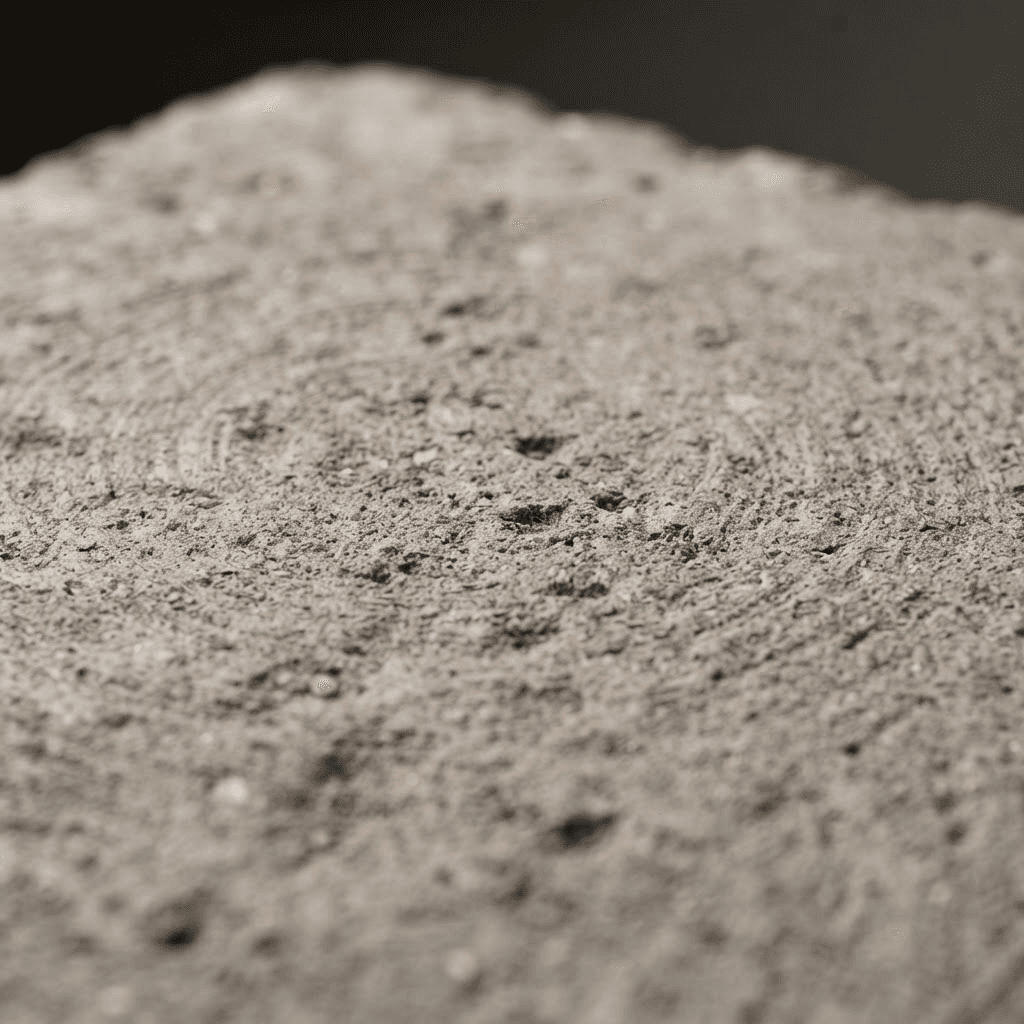
This is what a slab should look like before any resin touches it: matte, open, and slightly dusty, with the pinholes and grinder swirl left in place. A slab that still looks sealed or shiny after preparation has not been opened, and no product bonds to a closed surface.
Side by side
Diamond grinding versus acid etching
Both get written on a quote as surface preparation. They are not comparable processes.
| Diamond grinding | Acid etching | |
|---|---|---|
| What it does | Mechanically removes the weak top layer and opens the concrete pore structure, creating a profile. | Chemically reacts with the surface and rinses it. No mechanical profile is created. |
| Contaminants | Removes existing sealers, adhesives, thin coatings and surface laitance along with the material. | Cannot remove a sealer or coating — the acid does not get through it to the concrete. |
| Surface left behind | Clean, dry, open concrete ready to accept resin. | A rinsed surface that must be neutralized and fully dried, often with residue left in the pores. |
| Consistency | Controlled and repeatable across the whole slab. | Varies with concrete hardness, acid strength, dwell time and how thoroughly it was rinsed. |
| Dust and waste | Dust captured at the tool by vacuum. Waste is a contained solid. | No dust, but acidic rinse water has to go somewhere. |
| Cost and time | Hours of skilled labor and specialized equipment. The most expensive line in the quote. | A fraction of the time and cost. This is why it still gets used. |
What comes off
Six things grinding removes
Some of these are visible before we start. Several only appear once the top layer is gone.
Surface
Laitance
The weak, fine layer at the very top of a poured slab, formed as water and fines rise during curing. It is not structurally sound, and a coating bonded to it is bonded to something that was always going to let go.
Contaminant
Existing sealers
Most slabs have been sealed at some point, frequently without the owner knowing. A new coating cannot bond through a sealer, and no chemical prep will remove one.
Contaminant
Old coatings and paint
Garage floor paint, previous epoxy and old sealers all have to come off mechanically. Where a full failed coating is involved, that becomes its own scope.
Contaminant
Adhesive residue
Tile mastic, carpet adhesive and glue from previous flooring. Common on interior slabs and invisible until the grinder exposes it.
Contaminant
Oil and grease penetration
Where oil has soaked into the concrete, grinding removes the affected material. Deep saturation may need additional treatment, which is assessed rather than assumed.
Surface
High spots and trowel marks
Grinding also flattens. Trowel ridges, high spots and minor unevenness get taken down, which matters most under a smooth finish like metallic or solid color.
Equipment & method
How we prepare a slab
- Walk-behind and hand-held diamond grinders sized to the area
- Vacuum extraction connected at the tool, not a shop vac afterwards
- HEPA-rated dust collection on the extraction
- Edge and corner tooling so the perimeter matches the field
- Containment of adjacent finished areas on interior and commercial work
- Moisture assessment before a system is specified
- Profile checked across the slab, not just where it was easy
Dust control is not optional
Grinding concrete generates a very large volume of extremely fine dust that carries a genuine respiratory hazard. It also travels — through a house, into HVAC returns, and across a commercial tenancy.
Extraction is connected at the tool so dust is captured as it is produced rather than swept up afterwards, with HEPA-rated collection on the vacuum. On interior and commercial work, adjacent areas get contained as well. This is a cost and it is not negotiable.
Context
Why etching persists, and what grinding reveals
Two things worth knowing: why the cheaper method is still common, and why grinding is also a diagnostic step.
Why acid etching persists
Etching is fast, cheap, requires no specialized equipment and produces no dust. Those are real advantages for a contractor working to a price, and it is genuinely better than doing nothing at all.
What it cannot do is create a mechanical profile, remove an existing sealer, or produce a consistent result across a slab. It also leaves behind a surface that has to be neutralized and completely dried before coating, and residual moisture is its own bonding problem. When a floor peels within a year or two, inadequate preparation is the usual root cause.
If a quote you are comparing describes "surface preparation" without saying mechanically ground, ask which method. It is the single most useful question you can ask.
What grinding reveals
Grinding is also diagnostic. It is the point at which a slab stops being an unknown: soft or friable concrete, adhesive residue, previously repaired areas, oil penetration and the true extent of cracking all become visible once the top layer is off.
This is a genuine reason we do not quote a firm price over the phone. We assess as much as possible at the inspection, and if grinding exposes something materially different we tell you before continuing rather than absorbing it silently or presenting a revised invoice at the end.
Terms used on this page
- Laitance
- A weak, dusty layer of fine cement particles brought to the surface during concrete finishing. A coating applied over laitance bonds to the laitance rather than to the slab, which is why the floor can peel away in sheets while the coating film itself is undamaged.
- Concrete surface profile (CSP)
- The ICRI scale describing how rough a prepared concrete surface is, from CSP 1 (nearly smooth) upward. Coating manufacturers name a target CSP in their data sheets; diamond grinding is how that profile is produced repeatably.
- Full-broadcast
- A flake floor in which vinyl chips are thrown into the wet base coat until the surface will not accept more, so the base coat is completely hidden. The alternative — a light scatter — leaves base coat visible between chips and uses a fraction of the material.
- Moisture vapor transmission
- Water vapor moving upward through a concrete slab from the soil beneath it. If the surface is sealed, pressure can build under the coating and lift it osmotically. Recognised test methods are ASTM F1869 (anhydrous calcium chloride) and ASTM F2170 (in-situ relative humidity probes).
- Mil thickness
- Coating thickness measured in thousandths of an inch. Target thickness is specified by the coating manufacturer for the specific product and application, so we quote it from the technical data sheet for the system going on your slab rather than publishing a general figure.
Technical references
- ICRIGuideline 310.2R — Concrete Surface Profile
- The CSP scale used to specify how much a slab must be opened before coating. Referenced by most coating manufacturers in their preparation requirements.
- ASTM InternationalASTM F1869 — Anhydrous Calcium Chloride Test
- Measuring the rate of moisture vapor emission from a concrete slab. One of the two standard methods for assessing whether a slab is safe to seal.
- ASTM InternationalASTM F2170 — In-Situ Relative Humidity
- Measuring relative humidity inside a concrete slab using probes set into drilled holes. Generally the more reliable of the two moisture methods.
- ASTM InternationalASTM D4258 / D4259 — Surface Preparation of Concrete
- Standard practices for cleaning and abrading concrete prior to coating, including mechanical abrasion.
- ANSIANSI A326.3 — DCOF Test Method
- The test method behind any credible slip-resistance figure for a hard surface.
- SSPC / AMPPSSPC-SP 13 / NACE No. 6 — Surface Preparation of Concrete
- Requirements for preparing concrete surfaces to receive protective coatings, widely referenced in commercial and industrial specifications.
Product-specific figures — dry film thickness, cure and return-to-service times, abrasion and chemical-resistance ratings, and warranty terms on materials — come from the current technical data sheet for the exact product installed on your slab. We provide those data sheets on request and do not reproduce their numbers here, because a figure quoted from memory or from a competitor’s site is how misinformation spreads.
Questions
Preparation questions
Why can you not just acid etch my floor?
Etching is a chemical rinse, not mechanical profiling. It cannot create the surface profile the resin needs to key into, and it cannot remove an existing sealer or coating. It is the most common root cause of a floor that peels within a couple of years, which is why we grind every slab.
How much dust does grinding create?
A lot — which is why extraction is connected directly to the tool with HEPA-rated collection, rather than sweeping up afterwards. On interior and commercial work we also contain adjacent areas. You should not end up with concrete dust through your house.
Do you have to grind if my slab is brand new?
Yes. New concrete has laitance at the surface — a weak layer of fines that rose during curing. It is not sound material, and a coating bonded to it is bonded to something that will eventually let go. New slabs also need to have cured sufficiently before coating.
What if you find something unexpected under the surface?
We tell you before continuing. Grinding exposes soft concrete, adhesive residue, oil penetration and the real extent of cracking. If it materially changes the scope you hear about it at that point, not on the final invoice.
Is grinding the same as concrete polishing?
They use related equipment but have different goals. Grinding here is preparation — creating a profile for a coating to bond to. Polishing is a finish in its own right, progressively refining the concrete surface to a sheen with no coating applied over it.
Can I grind my own slab before you arrive?
We would rather you did not. Profile depth and consistency matter, and correcting an over- or under-ground slab is more work than doing it once properly. It is also the step our warranty depends on, so it needs to be ours.
Get an itemized quote after we have seen your concrete
Every estimate is free, happens onsite, and comes back itemized. No payment is due upfront.
- $2M general liability + workers’ comp
- 5-year workmanship warranty
- No upfront payment