
Exterior concrete
Patio & Pool Deck Concrete Coatings
An outdoor slab is not a garage floor with weather on it. UV, standing water, barefoot traffic and thermal movement make it a different specification — and we assess it separately.
Can concrete patios and pool decks be coated?
Short answer
Yes, but the specification changes outdoors. Exterior slabs get full sun, standing water and bare feet, so a UV-stable topcoat is essential and slip resistance has to be built in rather than assumed. Drainage and how the slab was originally poured both matter considerably more outside than they do in a garage.
Professional recommendation
Outdoors, slip resistance and UV stability are not upgrades — they are the specification. A garage build applied to a pool deck is the wrong floor in the wrong place.
- Choose it when
- You want a sealed, cleanable, non-slip surface on a sound exterior slab that drains properly.
- Look elsewhere when
- The slab holds standing water, or has movement or drainage faults. Coating over a drainage problem traps it, and on a pool deck that is a safety issue rather than a cosmetic one.
Houston Superior Epoxy
At a glance
- Installation time
- A multi-day installation, and outdoor work is weather-dependent — humidity and dew point affect cure, so dates can move.
- Return to service
- Foot traffic returns before vehicle traffic. Exact hours are set by the installed system’s technical data sheet and by cure-day temperature and humidity, so they are given in writing at the final walkthrough rather than published as a fixed number.
- Preparation method
- Mechanical diamond grinding with dust control. Never acid etching.
- Warranty
- 5-year written workmanship warranty
- What drives cost
- Area and shape complexity — pool surrounds have far more edge per square foot
- Anti-slip aggregate, which outdoor surfaces should have
- Slab condition, drainage and any repair needed first
Outdoor conditions
Six factors that only apply outside
These are the reasons an exterior slab gets its own assessment rather than the garage specification applied outdoors.
Safety
Slip resistance when wet
An exterior slab gets wet, and a pool deck gets wet constantly with bare feet on it. Texture is added deliberately to the topcoat rather than treated as an afterthought, and how much is a conversation about comfort versus grip.
Exposure
Constant UV exposure
A clear epoxy left in direct sun ambers over time. That is why exterior work gets a UV-stable topcoat — outdoors this is not a preference, it is the difference between a floor that holds its color and one that yellows.
Comfort
Surface temperature underfoot
Color and finish affect how hot a slab gets in direct Houston sun, which matters on a pool deck people walk on barefoot. Lighter tones and texture both help, and we talk it through before you choose.
Substrate
Drainage and standing water
Where water sits after rain tells us a lot. Slabs that pond need that understood before coating, because a coating does not fix a drainage problem and standing water works on any edge or detail it can find.
Substrate
Thermal cycling
Exterior slabs expand and contract far more than a garage floor, cycling between full sun and cool rain. That movement is why crack detail on an exterior slab gets more attention, not less.
Exposure
Pool chemicals and salt
Pool deck coatings live with chlorinated or salt water splashing on them continuously. Chemical exposure feeds into which system gets specified for the deck versus a covered patio.
Surfaces
Exterior surfaces we coat
- Open patios and back porches
- Covered and screened patios
- Pool decks and surrounds
- Walkways and garden paths
- Outdoor kitchen and grill areas
- Front entries, stoops and landings
- Carports and porte-cochères
- Exterior stairs and landings
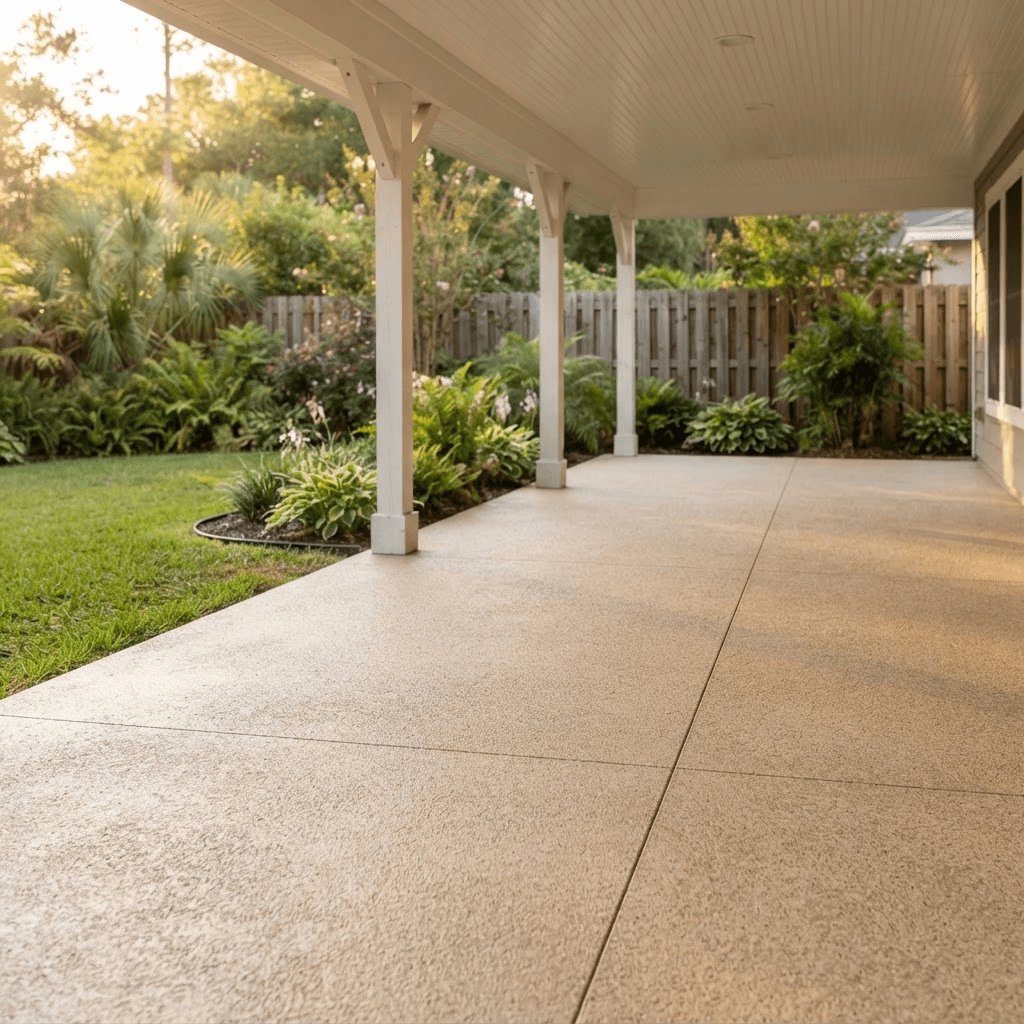
That is an illustration of a textured exterior finish rather than a photograph of one of ours — the low light across it is there to show the slip-resistant texture. Exterior project photography is being shot on completed installs for the project archive, rather than licensed from a stock library.
What to expect
How exterior work differs in practice
Specification, scheduling and assessment all change once the slab is outdoors.
Why an exterior slab is assessed separately
A garage floor lives in a stable, shaded, dry environment. An exterior slab in Houston deals with direct UV, driving rain, standing water, and a surface temperature that can swing significantly in a single afternoon. Those are different engineering conditions, and they lead to different specifications.
This is the clearest case where the chemistry choice stops being a matter of taste. A clear epoxy topcoat outdoors will amber under sustained UV. The topcoat on an exterior slab needs to be UV-stable, and the texture in it needs to account for the surface being wet with people walking on it.
Weather affects the schedule, not just the design
Coatings cure in relation to ambient temperature and humidity, and an exterior install has no roof over it. Rain in the forecast, an unusually humid stretch or a very hot afternoon can all move an exterior start date.
We would rather move a date than install into conditions that compromise the floor. When we schedule exterior work we tell you what the weather constraints are, so a reschedule is an expected possibility rather than a surprise.
What we look at during the estimate
Where water goes after rain, whether the slab has settled or cracked, how much direct sun it takes and at what time of day, what the transition looks like at doors and pool coping, and what the slab has been sealed or painted with before.
Existing sealers matter more outdoors than people expect. A previously sealed patio may need that material removed mechanically first, because a new coating will not bond through it. That is assessed before any number is quoted.
Terms used on this page
- Aliphatic
- A class of polymer chemistry that resists ultraviolet degradation. Aliphatic coatings such as polyaspartics and aliphatic urethanes hold their colour in sunlight; aromatic chemistries such as standard epoxy do not.
- Polyaspartic
- An aliphatic polyurea coating chemistry used as a clear topcoat. Being aliphatic, it is UV stable, which is why it goes on top of an epoxy base rather than the other way round. It also cures quickly, which shortens return-to-service but narrows the window an installer has to work the material.
- Epoxy
- A two-part thermosetting resin used as a base coat. It bonds strongly into ground concrete and builds thickness well. It is aromatic, so it ambers and chalks under sustained sunlight — a documented property of the chemistry, and the reason it belongs underneath a UV-stable topcoat.
- DCOF
- Dynamic coefficient of friction — the measured standard for slip resistance, tested under ANSI A326.3. It is a number produced by a test, which is why we describe slip resistance in terms of what aggregate is added rather than with adjectives.
- Moisture vapor transmission
- Water vapor moving upward through a concrete slab from the soil beneath it. If the surface is sealed, pressure can build under the coating and lift it osmotically. Recognised test methods are ASTM F1869 (anhydrous calcium chloride) and ASTM F2170 (in-situ relative humidity probes).
- Spall
- A patch where the concrete surface has flaked, chipped or broken away, leaving a shallow crater. Spalls are repaired and levelled as their own step before any coating is applied.
Questions
Patio and pool deck questions
Will a patio coating be slippery when wet?
Texture is added to the topcoat specifically to address that, and how aggressive it is is a decision we make with you. More texture means more grip and a slightly rougher surface underfoot; less means smoother and more slip when wet. On pool decks we lean toward grip.
Will it get too hot to walk on barefoot?
Any concrete in direct Houston sun gets hot. Color choice and texture both influence how hot the finished surface feels, and lighter tones help. It is worth raising during the estimate if the deck is used barefoot.
Can you coat over my existing patio sealer or paint?
Not reliably. A new coating needs to bond to the concrete, not to whatever is currently on it, so existing sealers and paints generally have to come off mechanically first. We assess that onsite because it materially affects the quote.
What if my patio has cracks?
They get repaired as their own step before coating. Exterior slabs move more than interior ones because of thermal cycling, so crack detail outdoors gets more attention rather than less.
Will rain delay my install?
It can. Exterior coatings cure in relation to ambient temperature and humidity with no roof overhead, so rain or an unusually humid stretch can move a start date. We will tell you the constraints when we schedule rather than install into bad conditions.
Does water pooling on my patio matter?
Yes, and it is one of the first things we look at. A coating does not correct a drainage problem, and standing water works away at any edge or detail over time. If your slab ponds, we want to understand why before specifying anything.
Get an itemized quote after we have seen your concrete
Every estimate is free, happens onsite, and comes back itemized. No payment is due upfront.
- $2M general liability + workers’ comp
- 5-year workmanship warranty
- No upfront payment